
Mission Statement
- Mission Our endeavor is to provide learning experiences through the provision of –
- Differentiated, in-depth and cohesive learning programs which stimulate and develop each child’s abilities to his or her highest potential.
- Highly motivated and dedicated teachers who are result-oriented through their commitment to ongoing professional development, quality teaching, coaching, mentoring, and collaboration.
- A learning environment that is responsive to students’ voices. Enriching and engaging resources.
- Opportunities for parents and guardians to take an active part in learning and decision-making policies
Vision
Our Vision is to be a premier global educational institution by providing a broader, bolder, holisticand more meaningful education. We strive to cultivate all-round qualities in a student throughexcellencein education that shall foster academic understanding, brilliance, spiritual well-being, psychological strengths, resourcefulness and creative skills, social responsibility and concern for one’s environment.
At Euro School the Committee that formulates the School Assessment Policy consists of the following members:
- Executive Advisor
- Pedagogical Leadership Team,
- Librarians, subject teachers and Parent Representative
Our vision of providing an outstanding international education is centered on the integration of all aspects of learning with:
- Attention to the whole child
- Emphasis on inquiry
- Integration of the traditional subject areas
- Utilization of a variety of learning tools and technologies
- Valuing a range of learning styles and abilities
- Exposure to diverse international perspectives
- Connections to the real world beyond the confines of the classroom.
- A commitment to active service and positive action
- A focus on the development of positive attitudes toward people, toward the environment, and toward learning.
IB Mission statement
The International Baccalaureate aims to develop inquiring, knowledgeable and caring young people who help to create a better and more peaceful world through intercultural understanding and respect. To this end the organization works with schools, governments and international organizations to develop challenging programmes of international education and rigorous assessment. These programmes encourage students across the world to become active, compassionate and lifelong learners who understand that other people, with their differences, can also be right.
Assessment beliefs
Assessment is the gathering and analysis of information about students’ performance. It identifies what students know, understand, can do and feel at different stages in the learning process.
All stake holders learners, teachers, parents, coordinators, and board members–must have a clear understanding of the reasons for the assessment, what is being assessed, the criteria for success, and the method by which the assessment is made.
Assessment is integral to all teaching and learning. It is central to the International Baccalaureate Primary Years Program’s goal of effectively guiding children through the five essential elements of learning: the understanding of concepts, the acquisition of knowledge, the mastering of skills, the development of attitudes, and the decision to take responsible action. Both learners and teachers should be actively engaged in assessing student progress as part of the development of their wider critical thinking and self-evaluation skills. Teachers should also be concerned with evaluating the efficacy of the program.
(Making PYP Happen 2009)
Purpose of assessment
The PYP describes the taught curriculum as the written curriculum in action. Using the written curriculum, and in collaboration with colleagues and children, the teacher generates questions which guide structured inquiry and instruction. These questions address the eight key concepts which help lead to productive lines of inquiry. Assessment focuses on the quality of student learning during the process of inquiry and instruction and on the quality of the products of that learning. Assessment is, therefore, integral to the taught curriculum. It is the means by which we analyze student learning and the effectiveness of our teaching and acts as a foundation on which to base our future planning and practice. It is central to our goal of guiding the child, from novice to expert, through the learning process.
Assessment is an essential part of the instructional cycle. It provides information about student learning and development, as well as a framework for planning, self-reflection, and collaboration.
Students’ learning is promoted through:
Assessing prior knowledge and experience
Engaging learners in reflection to determine strengths and weaknesses and to set goals
Differentiating instructions to meet individuals needs:
Providing feedback for students
Expanding student learning opportunities
Building a profile of children’s understanding
Principles of Assessment
The essential agreement on assessment is a product of a collaborative effort by the staff. It recognizes that the fundamental purpose of assessment is to acknowledge student learning. It incorporates the IB PYP five essential elements: key concepts, knowledge, attitudes, skills, and action.
Effective assessment should:
- Provide feedback for students and teachers to revise/advance performance, learning, and teaching
- Be formative, summative and demonstrate what students know, understand, and are able to apply
- Use reflection as an essential and integral part of self, peer, teacher, and parent assessment
- Be anchored in Authentic Tasks
Provide evidence of progress along a continuum of criteria that are clearly known and understood in advance.
Characteristics of effective assessment
Highly effective assessment shares some key characteristics (Adapted from Clarke 2012).
Authentic: It supports making connections to the real world to promote student engagement.
Clear and specific: This includes desired learning goals, success criteria and the process students use to learn.
Varied: It uses a wider range of tools and strategies that are fit for purpose in order to build a well- rounded picture of student learning.
Developmental: It focuses on an individual student’s progress rather than their performance in relation to others.
Collaborative: It engages both teachers and students in the assessment development and evaluation process.
Interactive: Assessment encompasses ongoing and iterative dialogues about learning.
Feedback to feedforward: It provides feedback on current learning to inform what is needed to support future learning (Hattie, Timperley 2007) and raises students’ motivation.
The PYP approach to assessment gives the students a vital role in the assessment process and engages the teachers in considering assessment as fit for purpose. Effective PYP assessment practice holistically integrates assessment for, of and as learning (Harlen, Johnson 2014) to support effective learning and teaching.
A. Diagnostic/ Pre-assessment
Pre-assessment occurs before embarking on new learning to uncover prior knowledge and experiences.
B. Formative Assessment
Formative assessment is woven into the daily learning process. It provides teachers and students with information about how the learning is developing. It helps the teacher to plan the next stage of learning.
C. Summative Assessment
Summative assessment occurs at the end of a teaching and learning cycle. Students are given the opportunity to demonstrate what they have learned by applying their knowledge in new and authentic contexts.
Assessment of the Essential Elements of the PYP
The five essential elements of the PYP are assessed through the units of inquiry and are recorded on the
planner for each unit.
Knowledge: assessment of the knowledge learned in each unit is done through the summative assessment. It reflects an understanding of the central idea.
Skills, concepts and attitudes: Each unit provides opportunities for different skills, concepts and attitudes. Reflection on growth in these areas is recorded on the planners and self-assessments are done by the students.
Action: Student actions that are initiated beyond the scope of the unit are recorded on the planner.
PYP V Exhibition
PYP Grade V students are expected to develop and present their own collaborative unit of inquiry that showcases the five essential elements of the PYP (knowledge, skills, concepts, attitudes and action). This is an opportunity for the learners to exhibit the attributes of the learner profile which they have been developing throughout the Primary Years Program.
Assessment Strategies
Through the IB PYP Program of Inquiry, teachers at Euro School strive to provide the opportunity for learners to construct meaning primarily through structured inquiry. This is accomplished by emphasizing the connections between subject-specific knowledge and transdisciplinary skills and themes and units of inquiry.
We assess performance and progress in each of the following subject areas: English language arts, Math, Science, Social studies, Art, Music, Drama and Nepali language arts. We continue to incorporate student attitudes and attributes to everyday learning.
Assessment strategies form the basis of a comprehensive approach and represent GS’s answer to the question, “How will we know what we have learned?” These methods of assessment include a broad range of approaches and have been selected to provide a balanced view of the student.
- Observations: All students are observed regularly with a focus on the individual, the group, and/or the whole class.
- Performance Assessments: Students are presented with a task that represents the kind of
In addition, it entails the thoughtful application of knowledge rather than recalling facts. It has an identified purpose or audience, involves a realistic scenario, it has an established criteria and requires developing an authentic product or performance.
Process-focused assessment: Teachers observe students with a particular skill in mind, noting students who are meeting, exceeding or struggling to meet the expectations.
● Open-Ended Assessments: Students are presented with a challenge and asked to provide an original response.
Student reflections: Students may are asked to reflect on what they have learned at the end of a unit/task.
● Tests/Quizzes: These single-occasion assessments provide evidences of students’ specific knowledge.
● Portfolios: An ongoing, purposeful collection will be composed of selected student work in each academic session and is designed to demonstrate growth, creativity, and reflection. Continuity Portfolios and Grade Level Portfolios are in use throughout the school.
Developing an integrated assessment culture
Strong communication, of the purposes of assessment and reinforcement of the value of assessment in the monitoring, documenting, measuring and reporting of learning, is important in building a shared assessment culture. A school-wide assessment culture acknowledges the role assessment plays in informing the learner, learning and teaching, and the learning community about achievement, progress and in supporting decision-making.
Establishing and fostering a school-wide culture around assessment begins by:
developing assessment capability within the learning community
developing a comprehensive assessment policy that emphasizes assessment integration
creating opportunities for teachers to plan, reflect and moderate assessment collaboratively
providing school-wide professional development opportunities around integrating effective assessment
reinforcing the role assessment plays in finding out what students know and can do, and in identifying the next steps for their learning
reinforcing the links between monitoring, documenting, measuring and reporting of learning.
Developing assessment capability to support learning
All members of the learning community develop assessment capability (Absolum et al. 2009) to make the “tacit knowledge that is ‘hidden’ within the learner transparent, explicit and available” (Clark 2012).
Members of the learning community are assessment capable when:
everyone is aware of, and understands, why and what to assess
everyone is aware of, and understands, what constitutes quality
there is a shared understanding of how to assess and what data is being collected, analysed and reported.
there is a shared language for talking about assessment
the assessment process is collaborative and inclusive of all members (Hipkins 2009; Booth, Hill, Dixon 2014)
When members of the learning community have a shared understanding and language to monitor, document and measure learning, they can make powerful contributions to learning and teaching.
In an assessment-capable learning community, everyone has a clear understanding of the reasons for assessment, what is being assessed, the criteria for success, and the methods by which the assessment is made. In so doing, the entire school community is involved in the inquiry regarding the efficacy of the programme implementation (Hipkins 2009). This could have a powerful effect on the development of knowledge, conceptual understandings and skills.
Teachers
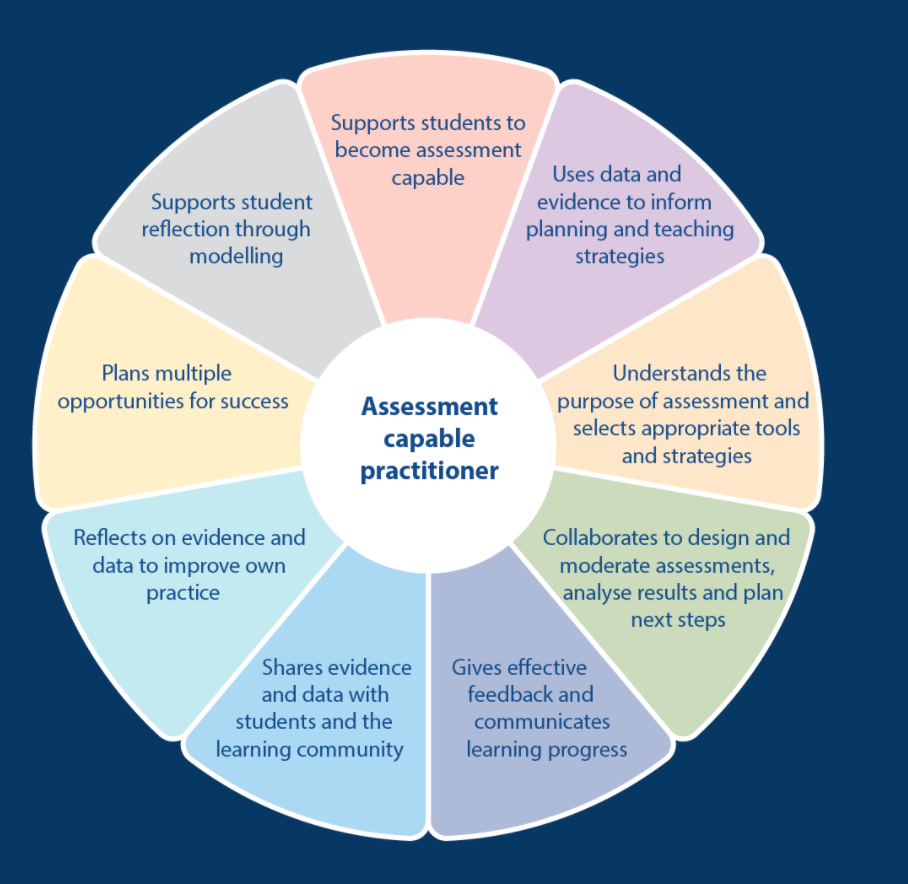
An assessment-capable teacher is supported through professional development and a shared assessment culture. As indicated in figure AS02, teachers support students to become
assessment capable in the following ways.
Teachers become more effective when they are open to actively learning about student progress by monitoring what they know, understand and can do. Teachers inquire into
student learning as a way of assessing their own practice as educators. They continually adjust their teaching to better support individual and group learning.
Teachers in a learning community ask the following questions.
What awareness and understanding do we have of student learning?
What is the evidence of what students can do, say, write, create and demonstrate?
How do we support students to understand what constitutes quality?
What other contexts can we provide for students to practise their skills?
What action needs to be taken to develop the learning further?
How will we know that we have sufficiently supported student learning?
How can we identify progression in learning across multiple contexts or units of inquiry?
How do we use evidence of learning to plan the next learning steps with students?
Students
Students develop assessment capability when teachers provide them with multiple supported experiences in reflecting on their learning and how to make improvements. Using specific language to describe, discuss and evaluate learning, students demonstrate their assessment capability by:
partnering with teachers to design their learning goals and success criteria
being able to self-assess and discuss their progress towards achieving learning goals
selecting evidence, such as samples of their learning, that best demonstrate the intended learning goal developing the metacognitive skills to reflect on their learning and to plan next steps
drawing on feedback and multiple strategies to adjust their learning and identify where and when to make improvements.
From self-assessing to self-adjusting
By taking an active role in their own assessment, students analyse how they think and learn. They develop skills to move from being self-assessors to self-monitors, with the aim of becoming self-adjusters.
Self-assessment involves students reviewing and evaluating their knowledge, conceptual understandings and skills. It then leads to students monitoring and adjusting their behaviour and planning, making corrections and implementing improvements in their learning. Self-adjusters use the feedback they are
given to modify and improve their learning. Self-adjusting therefore requires both thought and action and supports students’ self-efficacy.
Assessment is a powerful tool to support students in becoming self-adjusting learners. As they reflect on their progress and set goals for future learning, they may consider the following questions.
What do I need to know?
What knowledge and skills do I need to develop in order to answer my questions?
What steps do I need to take to ensure that my learning exemplifies quality?
What further possibilities do I see?
How do I incorporate feedback to achieve my learning goals?
Co-constructing learning goals and success criteria
Students and teachers set and reset learning goals to answer the questions “Where am I going in my learning?” and “What do I need to get there?” These are personalized for each student and connect new learning to prior learning. Learning goals are revisited throughout the learning process to monitor progress.
In PYP schools, personal learning goals support the creation of high expectations by:
making learning transparent to the teacher, the student and their families
building a shared understanding of what learning is to be achieved
encouraging reflection and focused feedback
inviting students to take ownership of their own learning.
Success criteria describe what quality and achievement will look like. They are specific and measurable. Students and teachers co-construct success criteria to answer the questions “What does successful learning look like?” and “What are we looking for during learning?”
Co-constructed success criteria support learning by:
building a common understanding of what constitutes quality
allowing for specific feedback on learning and feed forward into next steps of learning providing the structure and language for reflection, self-assessment and peer feedback providing the criteria against which learning is measured.
Young students’ learning is measured against individual developmental milestones and celebrates achievements at times that are pertinent to them. Students in the early years learn about the role of learning goals and success criteria over time. Teachers support students’ development of goal and success criteria setting skills by modelling the skills and by offering multiple opportunities for students to practice them.
Designing assessment to inform learning and teaching
Assessment in the PYP has generally followed the “backwards by design” process (Wiggins and McTighe, 2005). This assessment philosophy encourages teachers to design assessment by first identifying the desired knowledge, conceptual understandings and skills, followed by the design of the assessment, and finally planning learning activities to ensure acquisition of knowledge, conceptual understandings and skills.
“Forward by design” takes into consideration what other learning may have occurred beyond what has been planned. This design approach supports the development of “soft” skills, that are not immediately measurable, and that can emerge through the learning process. Forward by design is particularly relevant in supporting the development of approaches to learning and for the learner profile. This encourages student participation in assessment design, inviting them to evidence what else they know or can do.
In the PYP inquiry learning environment, the learning process is valued as much as the learning outcomes. Designing assessment that are both backward by design and forward by design will ensure that knowledge, conceptual understandings, skills and attributes of the IB Learner profile are monitored, supported and valued.
In designing a holistic assessment, teachers consider the following questions.
What learning goals will be achieved?
How can I involve students in the assessment design?
How could students engage in dialogues with teachers about the development of learner profile attributes?
What data or evidence should be gathered?
What tools or strategies should be used to gather data?
How will the evidence be monitored, documented and measured?
How could students be asked to evidence any additional learning?
How will the results be shared to feed back to the student?
How will the results be used to inform next steps in learning and teaching?
How will the results of the assessment be used to inform the learning community?
Assessment Tools
The previously identified assessment strategies are put into practice at Euro School by using the following assessment tools.
Rubrics: Rubrics are established sets of criteria used for scoring or rating children’s tests, portfolios, or performances. The descriptors tell the child and the assessor what characteristics or
signs to look for in the work and then how to rate that work on a predetermined scale. Rubrics can be developed by children as well as by teachers.
Exemplars: These are samples of children’s work that serve as concrete standards against which other samples are judged. Benchmarks/exemplars can be used in conjunction with rubrics or
continuums. Benchmarks should be appropriate and useable within a particular school context.
Checklists: lists of information, data, attributes or elements that should be present in students’ work or performance.
Anecdotal records: brief, written notes based on observations of students.
Continuums: visual representations of developmental stages of learning that show a progression of achievement or identify where a student is in a process.
Reporting to stake holders Conferences
1. Teacher-Student:
These are designed to give students feedback so they can reflect on their work and further refine and develop their skills. It is important that these individual conferences occur frequently in order to support and encourage the students’ learning and teaching planning.
2. Teacher-Parent
These are designed to give the parents information about the students’ progress development and needs, and about the school’s programme. Teacher should take this opportunity to gather background information, to answer the parents’ questions, to address the concerns, and to help define their role in learning process. The parents should take the opportunity to provide the teacher with the cultural context of the students’ learning.
3. Student-led
Student- led conferences involve the students and parents. The students are responsible for leading the conference, and also take responsibility of their learning by sharing the process with their parents. It may involve students demonstrating their understanding through a variety of different learning situations. There may be several conferences take place simultaneously.
The conference will involve the students discussing and reflecting upon samples of work that they have previously chosen to share with their parents. These samples previously selected with guidance and support from the teacher, and could be from students’ portfolio. The student identifies strength and areas of improvement. It enables parents to have a clear insight about the work their child is doing and offers a chance for them to discuss it with their child. The conferences must be carefully prepared, and time must be set for students to prepare their presentations. The format of presentation depends on the age of the student and all participants must understand the roles prior to the conference.
4. Three-way
Parents, students, and teachers are all valued partners in the reporting process and in sharing the responsibility both for learning and for accounting student progress. Pathways for communication need to be open and reciprocal.
Euro School builds in calendar an annual parent-teacher conference. In addition, we provide many opportunities throughout the school year for conferencing. Parents, teachers, and/or students may participate, depending upon the purpose.
Written Reports
Written reports are seen as a summative record for students, parents and the school itself of a student’s progress. Reports clearly indicate areas of strength and areas for improvement. All reports address the essential elements and the IB Learner Profile attributes.
1. Unit reports
At the end of each unit we send reports that clearly indicate areas of strength, areas of improvements, and where students are involved in providing input through self assessment. Since IB units are not reflected on our district report card, we strive to communicate, share, and reflect on student learning at the end of each unit.
2. End of term report
The school year is divided into three terms-two PYP units for each term. To meet the requirement givenby Ministry of Education, we have to take quarterly assessment. Detailed Report cardsare produced attheendoftheseterms.ReportcardsaredevelopedkeepinginviewthelocalneedsandtheIBrequirements. The Report card informs of student progress and areas of improvement in various subjectgroups, UOI, Learner profiles and the Transdisciplinary skills of a child. The reporting is done based onthe UOI completed during the term. A PTC is held to discuss the students’ progress at the end of eachterm.
- Portfolios will be used as a purposeful collection of a student’s work designed to demonstrate successes, growth, higher-order thinking, creativity and reflection.
Also as a cumulative collection of student work that would travel with the student from PYP Pre-Nursery to PYP V. These portfolios will be housed in the students’ classrooms and accessible to them and their parents at any time during the school year. The portfolio is the property of the student and goes with the child upon leaving or graduating from the program.
Assessment Review
The assessment committee reviews assessment and relevant policies annually. The review is based on the feedback of students, parents and teachers.